Copyright © 2025 Towasze.Studio - All rights reserved.
Copyright © 2025 Towasze.Studio - All rights reserved.


For many family forest owners, decisions about timber and land are made against life events and real financial pressures. A death, medical expense, business need, or division of an estate can create an immediate demand for cash. In those moments, a timber buyer or developer may present one clear number, while the case for continued ownership is spread across years and several sources of value. That difference in timing can shape the decision before forestry enters the conversation.
No stack of forest values will look the same everywhere. Timber volume and quality, access, local markets, tax treatment, and conservation potential all vary by property. In many places, even the best combination will not exceed what the land could bring for development. Managing a forest also tends to produce value over time, while an aggressive harvest or land sale offers a larger payment now. This is not a theoretical pressure; it is already contributing materially to the loss of family-owned forests. Recent research estimates that family forestland is declining by roughly 2.5 million acres per year, with nearly two-thirds of that acreage being converted to non-forest uses.
A short-sighted timber harvest is different from development, but it can still have long-term consequences. High-grading may remove the most valuable trees while leaving poorer growing stock, weak regeneration, and fewer future options. The immediate check may be attractive, but the owner can lose future timber income and ecological value. As the forest’s ability to generate value declines, retaining it becomes harder to justify, making eventual parcelization or development more likely.
Thoughtful, intentional forestry changes that calculation. A well-designed harvest can generate income while protecting or improving the stand that remains. The relevant comparison is not simply between different versions of how much can be cut today. It is those current payments plus their impact on the value of the residual forest, its expected growth, the quality of its regeneration, and the revenues it may produce in the future. A more restrained harvest may produce less cash now but leave the owner with a substantially stronger asset for the future.
Sometimes the right first action will generate little income, or even come at a cost. A landowner may need to invest in thinning, regeneration, or access before the property can produce stronger returns. That is not necessarily a failure of forestry economics. Owners invest in other long-lived assets to improve their future value. Good financial analysis should make the timing, costs, risks, and expected benefits clear enough for a family to make an informed choice.
Thoughtful forestry can also enhance the non-financial values that often motivate families to retain land. Silviculture can improve wildlife habitat by creating a better mix of age classes and retaining important food and cover. It can protect scenic areas, maintain access, reduce erosion, and make the woods healthier and more enjoyable. These outcomes are not separate from productive forestry; they are part of what well-designed management can deliver.
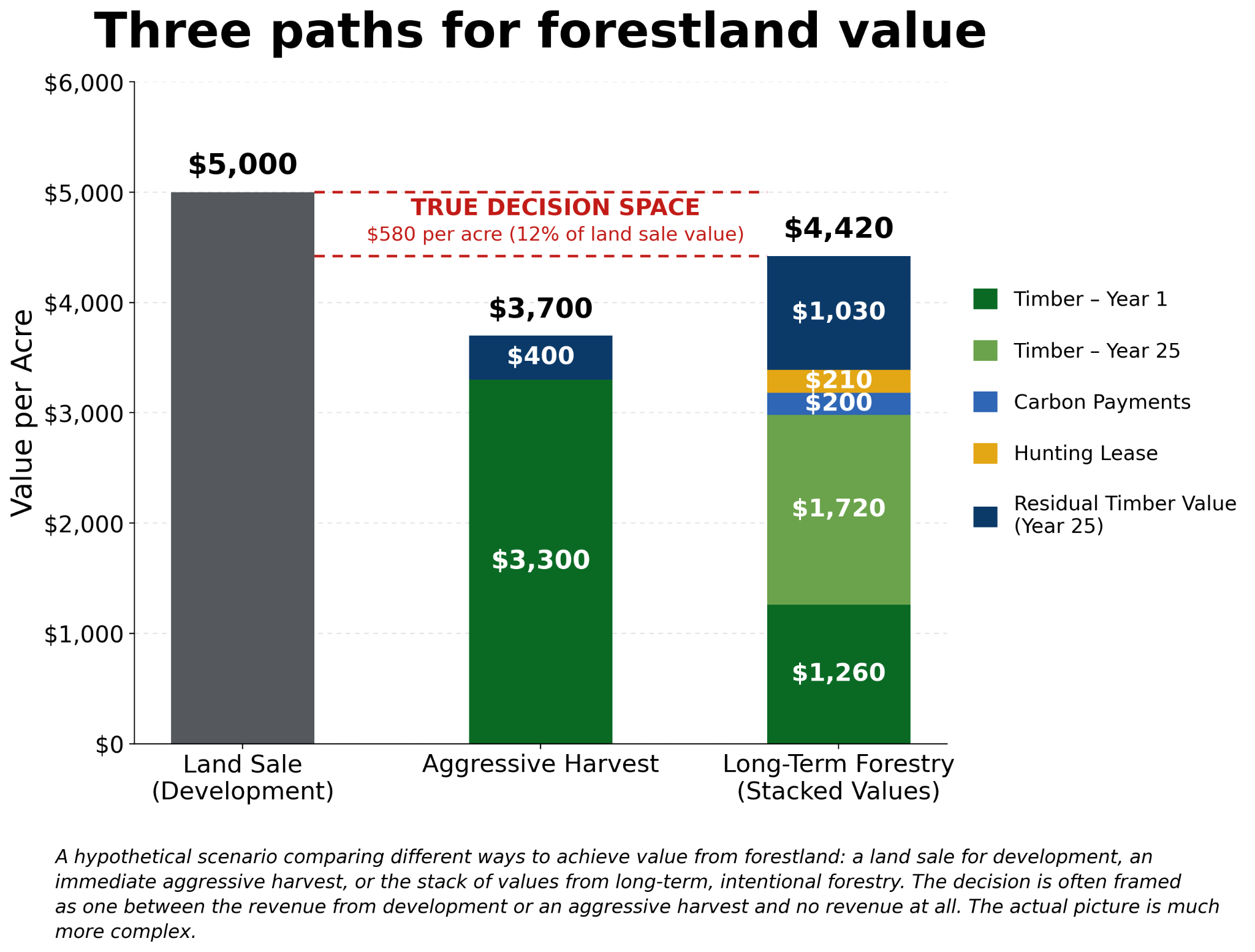
Other financial values can reinforce the case for keeping the forest as a forest, but they should be presented conservatively. Tax treatment, conservation funding, recreation income, and environmental markets may matter on some properties and not at all on others. The goal is to identify the values that are real and compare them over the same time horizon. Even then, good forestry may not match a development offer dollar for dollar, but it may not need to. If good management narrows the financial gap, the family’s values—legacy, privacy, wildlife, beauty, and continuity—may be enough to favor retention.
Professional forestry cannot prevent the life events that force difficult decisions. It can, however, help create a financial buffer through periodic income, a stronger residual asset, and better future options. When pressure arrives, the family is no longer choosing only between immediate liquidation and sentiment. It owns a productive forest with a credible long-term strategy—and a better chance of remaining intact. Foresters who can present their clients with the true value of the alternatives, including both near-term cash and long-term asset value, can help turn forest retention from a sentimental preference into a financially credible choice.