Copyright © 2025 Towasze.Studio - All rights reserved.
Copyright © 2025 Towasze.Studio - All rights reserved.

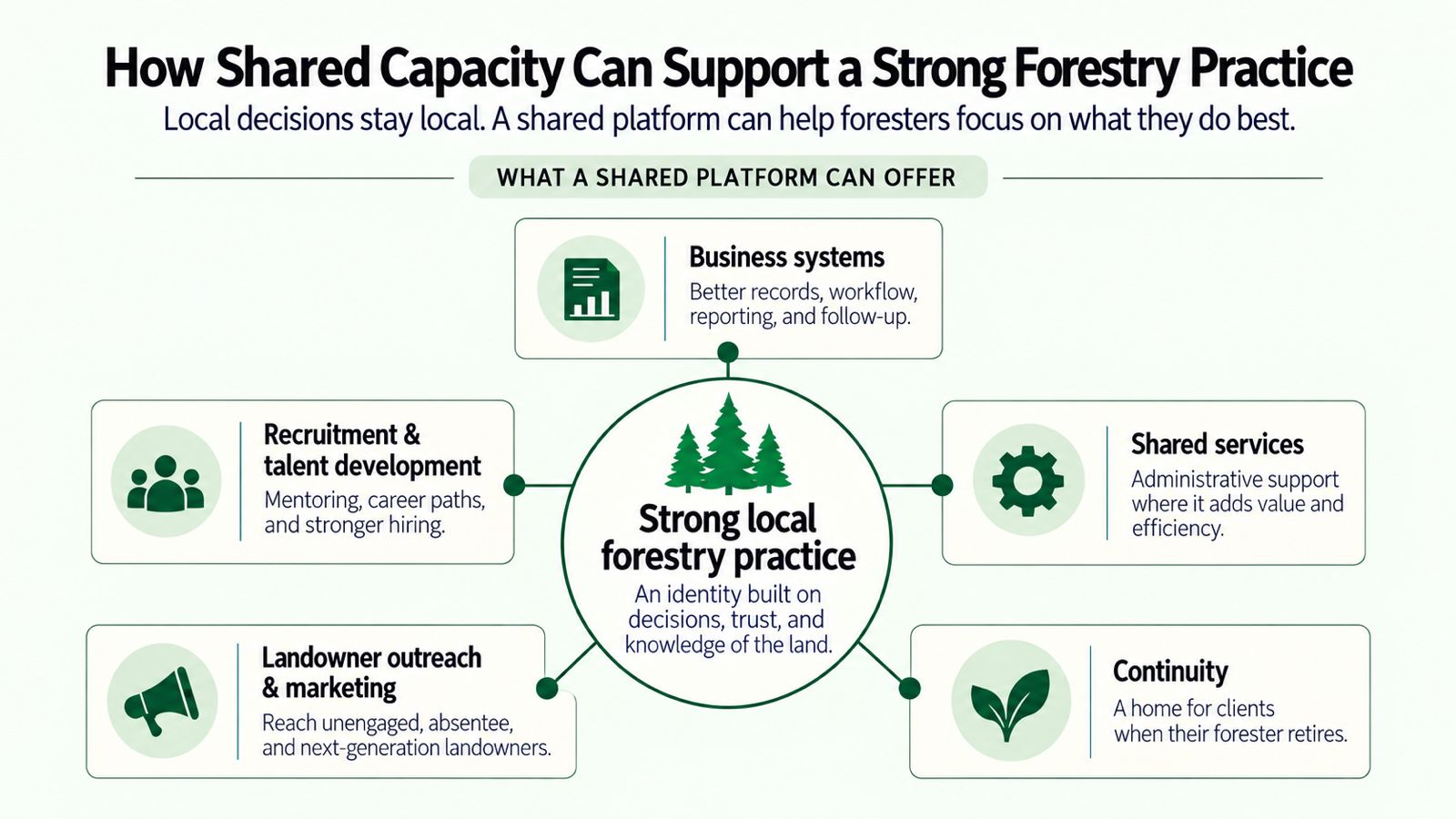
Forestry is local work. Strong firms are built on judgment, trust, and knowledge. Knowledge of the land, markets, contractors, and communities they serve. That wisdom and those relationships take years to develop, and they are the part of a forestry practice that is hardest to reproduce. Shared capacity can help firms build on those strengths—reaching more landowners, supporting their people, and broadening their capabilities while keeping forestry decisions and client relationships local.
The expectations placed on consulting foresters are growing. Foresters are being asked to reach owners who may live far from their land, help them understand a complex asset, explain long-term financial tradeoffs, navigate changing regulatory and market conditions, and remain involved long enough to turn recommendations into action. At the same time, they still need to spend time on the land, design treatments, supervise work, and maintain the relationships on which the practice depends.
Some firms will build the business infrastructure needed to support that work entirely on their own. Others may benefit from drawing on a broader platform while remaining locally led and operationally independent. The value comes from adding support around an already strong practice: better business systems, shared services where they add value and efficiency, stronger recruitment and professional development, and more effective landowner outreach.
Business systems are not the most visible part of forestry, but they shape whether good intentions are carried through. Organized client records, scheduled follow-up, reliable financial reporting, and useful technology help a firm maintain continuity and act on the right information at the right time. Shared administrative services can reduce duplicated effort in areas such as accounting, payroll, insurance, compliance, and routine reporting. Handling that repeatable work consistently leaves local foresters with more time for landowners and the woods.
A broader organization can also strengthen recruitment and professional development. Recruiting one forester at a time is difficult for a small practice, and developing someone into real client responsibility takes years. It can maintain relationships with forestry schools, offer stronger benefits and clearer career paths, and give younger foresters access to mentors and peers beyond a single office. That can make it easier for a local firm to grow without asking one owner to carry every part of recruitment, supervision, and professional development.
Shared capacity can also improve outreach. Many good firms still grow mainly through reputation and referrals close to the land. Those channels will always be important, but reaching unengaged, absentee, and next-generation landowners often requires sustained digital outreach and professional referral relationships beyond what many smaller firms can support on their own. Shared educational content, digital marketing, and relationships with attorneys, accountants, and financial advisors can bring those owners into contact with the right local forester. A shared platform can provide broader reach while each local firm builds and maintains the client relationship.
Continuity may be the most important benefit. When a respected forester retires, clients can lose decades of property history and trust. A strong local firm with additional staff and operating support may be able to take on those relationships, preserve the record, and introduce a successor before the connection is lost. That gives the retiring forester confidence that the landowners and forests they served will continue to receive thoughtful, locally grounded advice.
This approach won’t fit every practice. Many independent firms are well suited to their owners, employees, and clients exactly as they are. For others, shared capacity can help make an already strong business stronger, helping it reach more landowners, develop its people, pursue opportunities that would be difficult to build alone, and continue serving clients long into the future. The right shared capabilities paired with strong local leadership can help an established forestry practice do more of what it already does best.